Thursday, March 26, 2015

Design

We don't realize it, but design influences every part of our lives. We are always being unconsciously influenced by the design of objects, a lot of thought goes into the way everything looks.

I made this in 50 min. 
I think there are two types of design, both important in their own ways, but pretty different from one another. Mechanical design is about making things function, making objects more efficient and able to do their jobs well. Visual design, on the other hand focuses on the way a product looks, not how it works. This part focuses on making an object visually appealing.

Both of these elements are equally important and wouldn't be as effective on their own. A product could be flawlessly designed in the mechanical department, but if it isn't nice to look at no one will pay attention to it in the first place. As for the other way around, no matter how pretty an object is, if it doesn't work and serve it's purpose, it's not much use.

When we buy something we take both of these factors into account, but do we pay attention to one more than the other? It would make sense that we would care about the function of a product the most, we want it to be useful, right? Sometimes though, a products visual design can influence us more.

You have probably seen some of these eos lipbalms before, so why are they popular? Because of the way they look, the round visual design is different than what you usually expect. So, the visual design is good, and that attracts buyers. The mechanical design though, is actually not quite as good. A round shape isn't practical, it's hard to fit in pockets and it rolls away easily too.

So if the mechanical design is not as good, why is this brand popular? The good visual design outweighs the worse mechanical design. This same company makes normally shaped lip balms too, but those aren't as popular, because their visual design isn't as good. Sometimes visual design can set a product apart more than its mechanics can.

A recreation layout of an article. 
There are more than one way to portray a visual design though, depending on who the target audience is. Changing the way you present an idea can attract different kinds of people. Compare these three websites, all aimed for different audiences.

This is the NFL website, which generally aims for an audience of men and boys. It's design is darker colors and textures that are supposed to look 'manly' and attract that certain audience. Sephora is a makeup company, their audience is generally woman. Their colors are lighter and the layout is a little sleeker. Last is the Toys R Us website. Because they are targeting kids, this page is brighter and more colorful. It's also more busy with patterns.

Any of these layouts used to target a different audience wouldn't make sense. Imagine the NFL's website using the Toys R Us layout. It would contradict itself and maybe even deter people from going there, thinking it was for kids. By narrowing down their target audience, and tailoring their products design to that audiences preferences, you can attract more people. Design is a simple idea, but working with it can make you ideas stand out even more. 

Friday, March 20, 2015

Pretty

I'm not pretty. Don't try to say otherwise, this is not a debatable point, it's a fact. My face doesn't have the right shapes in the right places that modern society somehow decided looks good, and I know that. I don't have delicate features, tan skin, dark lashes or big eyes, but that's fine. I don't want to be pretty.

Now, if you are pretty, if you were by chance born with the right combination of genes that make your face somehow fundamentally more beautiful, don't take offence. Being pretty isn't a bad thing. Well, it isn't a good thing either. In fact, it really shouldn't be a thing at all, prettiness. Why did we decide that some random features were pretty, that certain faces are better looking than others?

When and why did we decide that this held any bit of importance in our lives? And how then, did we let it collect so much importance that society started to base real people's value on their faces, on their genes, on completely random factors that no one can control about themselves? We put way too much emphasis on the way we look, and it starts to influence our own ideas of self worth.

Advertisements surround us telling us how to lose weight fast, and smooth out our skin, and be prettier and more desirable. Our main goals in life should not be based on the idea of being desirable to anyone, we don't owe anyone anything, especially concerning the faces we were born with and can't change.

We don't tell little girls that they are inventive, or smart, or imaginative. We say 'you look so pretty!' and expect it to be the ultimate complement. Beautiful should not be our main focus, and pretty should not be our only compliment to one another.

Ask a little girl what she want's to be when she grows up. A doctor? A marine? No, she wants to be a princess. That's fine, princesses are great, but does she really want that? No. She wants to be a beautiful princess, and she wants all the boys to faun over her because she is so pretty.

If you want to try to make yourself pretty do it. Wear makeup if you want, dress up if you want, but do it for yourself, not for society, not to feel desirable, and not because you just feel compelled to. Never feel like less of a person because your face doesn't look 'pretty'.

Every time you think you aren't pretty, or struggle with body image issues, remember that beauty isn't actually real, we totally made it up. It doesn't really mean a thing. Strive to stand out because of your ideas, your feelings, your beliefs and passions. What is going on inside your head is so much more significant than the features on your face.

Sunday, March 8, 2015

Net Neutrality


The internet is a relatively new invention but it has quickly become a big part of almost everyone's lives. It's meant to be an easily accessible place, free for everyone to use, that allows you to go to any website or place online you want. The internet gives us the ability to connect with other people, no matter where they are, and that's pretty awesome.

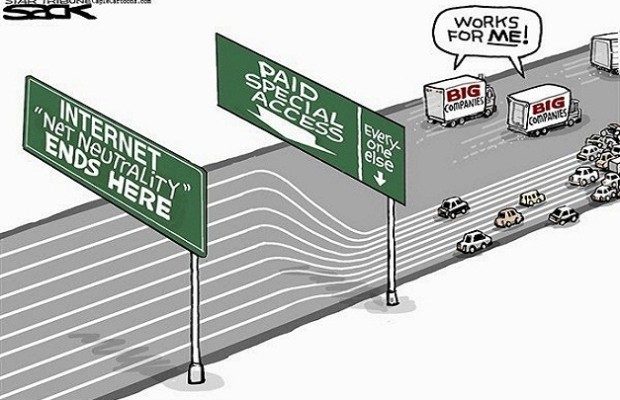
The big idea that makes the internet such a cool place is that it's available for everyone to use, and doesn't give anyone special treatment. The problem is, that these most basic aspect of the internet could be taken away.

Internet Service Providers, or ISPs want to be able to manipulate the places we are able to go online. They have the potential to make us pay for workable internet speeds and pay to visit certain websites. They could also make it harder for us to get to pages they don't want us to see, like pages advertising their competitors, or pages that voice views they don't agree with.

http://www.wordstream.com/blog/ws/2014/04/18/what-is-net-neutrality

Net Neutrality would protect us from these things happening by making sure ISPs can't give special treatment and better internet to any websites or higher paying customers or companies, while simultaneously giving everyone else worse connection. It would protect against this biased way of limiting our freedom to see, access, and share what we want online. This example of the internet without Net Neutrality shows what a difference this could make. 


http://apekmulay.com/why-net-neutrality-preserves-a-free-market-economy-for-iot-success/

On February 26, 2015 the FCC passed new regulations in favor of Net Neutrality. This is a big step, but we still aren't quite to where we could be. These new favorable rules are expected to face some roadblocks with congress soon.

The internet is an amazing place that's free to the public, and we want to keep it that way.  We can't let ISPs control what we can and can not access online. It's important for us to fight to make sure we can keep our internet the way it's supposed to be.

Thursday, March 5, 2015

Choice

Our lives are nothing but series of millions of tiny decisions. These decisions are made both by us, and for us by others. Sometimes we don't even have control over these choices but without them, we wouldn't be able to move forward.

Everything you do is a choice, and you have a choice in almost all aspects of your life. If you don't like what's happening you have a chance to change it, or at least change a little bit of it to make it better.

Our daily routines consist of endless choices about everything from what we wear to what we believe and how we think. Out of all these choices you make, every single one has an affect. It may affect only you, or it could affect people all around the world and into future generations.

People generally make choices in one of two ways, 'maximizers' like to review all options and make an educated decision while 'satisficers' settle with a choice more quickly. We all have methods to making decisions, but whether you are more or less thought out in your decision making process, there is still an element of thought there. This part of thinking is deliberate, you have to realize and focus on the decision you are making.

There is another part of decision making though, one that's more automatic. In this part of thinking your brain makes decisions for you that you are unaware of. We need this part because making conscious decisions all the time tires our brains out. Making decisions requires attention and you can't multitask very well while trying to make a good decision. This is when the automatic part of your brain takes over.

Making choices, consciously or not, definitely makes an impact. Even if a choice you make seems stupid and inconsequential to you, it might affect more parts of your life. The more little decisions you make, the more they can build up, and when they are all added together it's easier to see the degree of change your choices can prompt.

I like the idea that we control our lives with the choices we make, that the universe doesn't know what's going to happen next. Nothing is predetermined, and everything that happens is spontaneous because no one and nothing knows what could happen next. When you make a choice it's you changing your own life, in tiny ways at a time.

If the amount of choice we have right now can get us this far, imagine what we could do with an even wider scale of choice. Would more choice in general be good? As much as it's important to have enough choice, if we have too much, we can get overwhelmed with the possibilities. I guess there's a place somewhere in between that would be the best for everyone.

Thursday, February 26, 2015

Journalism in the Future

Journalism is never going to die. New journalism is constantly being produced, as long as we continue to share ideas with each other, we are using journalism.

To me, the spreading of any kind of information through any medium is journalism. This means that in order for journalism to end, the sharing of ideas would need to end, and almost all communication would need to end. That's not happening. What could happen though, is changing the format of our journalism, especially online.

A large portion of journalism consists of the news, focusing on events. News distributed through papers is falling while news distributed online is becoming more popular. Eventually online news will replace paper entirely.

The internet is generally seen as a place where people can connect, it can bring people together from all over the world. Paper newspapers provide no place for you to share your opinions or view other peoples opinions. If news is going to be all online, we should take advantage of the fact that people can so easily connect there.

The future news network we created, newsapp, encourages you to share your opinion and see others views too. I think that this journalism should include more that just articles about events. It should also feature opinion papers so that you can learn multiple viewpoints, and generally a more citizen based source of news, rather than only professional sources. Although citizen based journalism may make stories less reliable, it would also make stories more personal and more relevant.

I also think that it would be important to make sure the news was accessible to everyone, everyone should have a chance to know what's going on in the world. This is why newsapp is a free app and website. It is also written in an easy to understand way, for the general public. There is no use in producing stories that few people can understand or relate to.

Our technology never stops evolving, and it will bring journalism with it. As our lifestyles change, journalism will need to change too.

Monday, February 16, 2015

Oversexualizing Girls in Media

We are used to seeing scandalous pictures of woman in our every day lives. It doesn't surprise us when we see magazine covers of girls with skin showing, or womans clothing ads with a clear lack of, well, clothing.

The number of woman sexualized in media has been steadily growing. This idea is now so common that it's easy to forget that these images shouldn't be normal.

Looking at popular culture can help us see the values we have, and tv and movies are a big part of pop culture right now. In family films, 28.3% of woman are shown wearing sexy outfits, compared to 8% of men. Only 22% of prime time tv shows have a gender balanced cast.

Image result for sexualizing women in media
http://www.buffalo.edu/news/releases/2011/08/12769.html
You may not have ever consciously realized this difference in the media before, but its easy to see when you are looking for it.

We now see images like this all the time, they don't seem very shocking to us, but when you sexualize men the way that we always sexualize woman, the difference becomes more obvious. Then it's easier to see how ridiculous these ads really are. Not only is the idea of sexualizing girls normal to us, the idea of sexualizing men in that way is very unnatural.

As this becomes more common, it's spreading more and we are starting to see even younger girls being sexualized.

http://www.ashleymilnetyte.com/ashleymilne-tyte/2013/07/

This normalizes further the idea that woman are only important for their looks and sex appeal. Showing young girls, or any girls in this way just furthers that negative mindset. Girls are growing up only wanting to be pretty and appealing, and our advertisements and media are doing nothing but encourage it.


http://www.inquisitr.com/326131/lana-del-rey-gq-shoot-criticized-as-sexist/
Objectification and oversexualiztion is becoming more common, it's important that we don't allow it to become normal, and that we give the right impression to young girls. 

Monday, February 9, 2015

Journalism and Kim K.

Chances are, you have seen Kim Kardashian's butt by now. Over 6.6 million people viewed the article containing her famous Break the Internet pictures within the first day of it being published, not counting views over social media. That's more people than live in the state of Minnesota, and most of them wouldn't have seen it if not for journalism.

Even if you haven't seen the specific pictures, you have probably heard about the event, either through social media or from friends. The pictures and information had to travel a long way to get from the original article to you, and the reason it was possible, was through journalism.

Journalism is traditionally thought of as being a reliable source, closely related to news, and very factual, but I think that journalism is much bigger than that. Journalism is a way to spread information of any kind, through any medium. Journalism can be news, but it can also be stories, feelings, and opinions.

This makes almost everything journalism. That means that when you tweet an opinion or story, or retweet something like it, you are spreading news, and contributing to journalism. Every person who tweeted #breaktheinternet was contributing to journalism, it doesn't matter what the content is, it matters that information is being spread. Everyone is a journalist, intentionally or not. Every time you tell a friend a story about your life, you are contributing to journalism. Journalism is much bigger than news.

News is a part of journalism but not the whole thing. I think of news is the type of source that the public generally expects to be true. News should have an aspect of legitimacy to it, while the only requirement for journalism is that information is being passed along.

Although journalism is more objective and less reliable than pure news, we still rely heavily on it. Imagine only being able to learn about events from news sources, you would likely never have heard about those Kardashian pictures, or about many other events and ideas that you now know of. No one went out and searched to find 'reliable sources' about the Break the Internet pictures, we saw them on social media.

No matter the relevancy of your words, you are constantly spreading ideas and contributing to the general knowledge of the public. Even if that knowledge is just about Kim Kardashian's Butt.